
welcome
Shiv Parvathi Nivas CIC
LONDON
Sanatan Dharm - The Art of Learning

NAMASTE
"The divine in me bows to the divine in you"
"Vasudhaiva Kutumbakam"
वसुधैव कुटुम्बकम्
The world is one family
"Atithi Devo Bhava" अतिथि देवो भव
The guest is divine
"Ahinsa Paramo Dharma"
अहिंसा परमो धर्मः
Non-violence is the highest duty
COMMONALITIES
Our Commonalities
.... across the seas
Our Ladies, Internationally
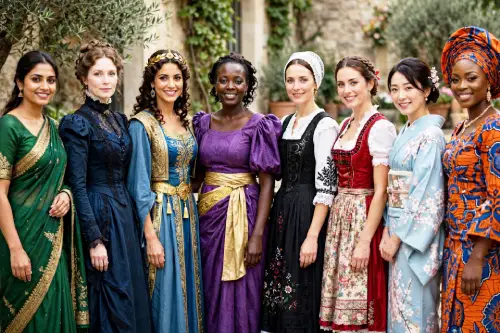
While the ladies have their own national costumes, the common thread is that they all look beautiful. There are many more things we have in common as living beings, including as humans, perhaps dating back to the beginning of the world. We have mentioned a few examples in the images below — not limited to humans — that we share universally. It is possible that many things we do today were done millions of years ago. Old traditions are continuously challenged, and we find that some things, like birth and death, are unchangeable. Sanatana Dharma and the laws of nature are timeless. We aim not only to work on matters that unite us, but more importantly on the positivity and good vibes that bring us together. Today, there is serious discussion about AI and its potential to harm humanity. and remembering what we share may be our best way to ensure technology remains human.

A New Arrival

A Family Wedding

A Tragic Loss
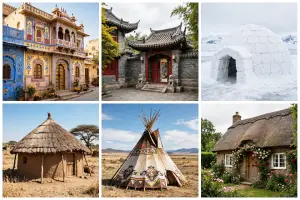
A Roof
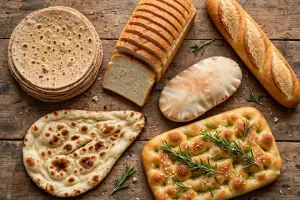
Sharing a Bread

Currencies
The images above represent just a few of life's fundamentals. Beyond them lie air, rain and sunshine, feelings and faith, belief and non-belief, love, pain and pleasure, parental care and language — the list is truly endless.
Ancient Teaching
Veda Teachings
Family Value and Ayurvedic Diet
1. Rigveda — The Veda of hymns and praise to the Devas, the oldest
2. Yajurveda — The Veda of yajna, rituals and mantras for worship
3. Samaveda — The Veda of music and chants, taken mostly from Rigveda
4. Atharvaveda — The Veda of daily life, healing, protection and wisdom for household life
Atharvaveda — The Veda of Daily Life
Atharvaveda is the fourth Veda. While the other three Vedas focus mainly on yajna and worship of Devas, Atharvaveda gives wisdom for everyday household life.
It contains:
- Mantras for healing and health
- Prayers for protection, peace in the home, and long life
- Guidance for family, society and right living
- Knowledge of herbs and nature
It shows that spirituality is not only in the temple — it is also in how we live, care for each other, and keep our home peaceful. This is very close to the message of Shiv Parvati Nivas — that home itself is a place of sadhana.
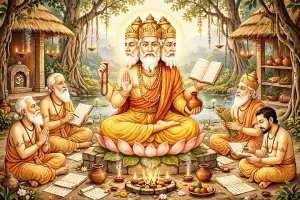
THE SOURCE - BRAHMAJI
Shree Brahmaji imparts the Vedas to the Rishis. While three Vedas guide worship, Atharvaveda guides daily life — health, home, family and healing. This is the foundation of our teaching.
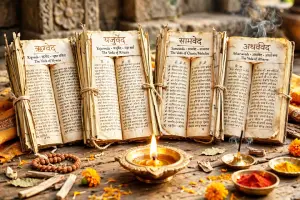
PRESERVED WISDOM
Ancient palm-leaf granthas hold timeless knowledge — herbs, mantras, and rituals for household peace. What our Rishis preserved, we practise today at Shiv Parvati Nivas London.
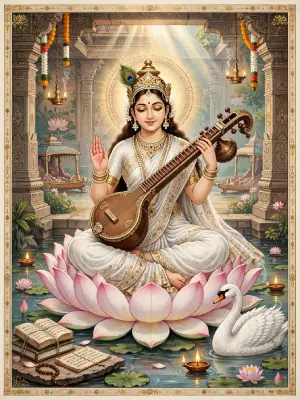
MATA SARASWATI — TEACHING
All vidya is blessed by Ma Saraswati. Seated on lotus with veena and books, she teaches us to speak with purity, learn with humility, and teach with love.
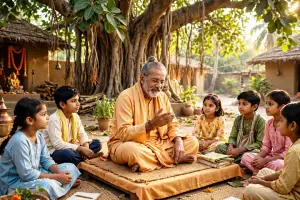
GURUKUL LEARNING
Our Gurukul is simple — Guru and shishya under the banyan tree. Children, parents and elders learn together. No pressure, only care, conversation and right company.
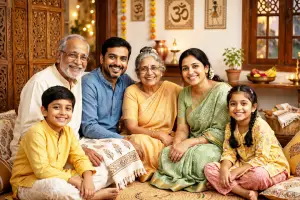
FAMILY VALUES
A peaceful home is heaven. Respect elders, love children, eat one bhojan together daily. When family time is protected, many problems dissolve naturally.

FOR ALL FAMILIES
We are in London. Indian or Western, joint or nuclear — values are same. At Shiv Parvati Nivas, every family is welcomed as our own, without judgement.
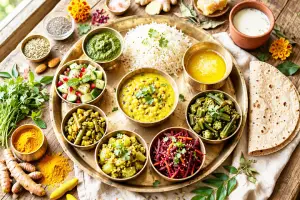
AYURVEDIC BHOJAN
Food is medicine. Our sattvic thali is fresh, seasonal and cooked with prayer. Eaten in moderation, it calms the mind, heals the body and brings family together.
MOTIVE
At Shiv Parvati Nivas London, our motive is simple and sacred — to bring ancient Vedic wisdom into modern household life. We follow Atharvaveda, the Veda of Daily Life, which teaches how to keep health, home and family in harmony. While other Vedas guide worship, Atharvaveda guides how we live, eat, speak and care for each other every day.
We believe family is the first Gurukul. In a time when families are busy and apart, we teach the value of sitting together — respecting elders, loving children, and sharing one sattvic bhojan daily. With right company, right conversation and right time together, many of today's problems dissolve naturally. We welcome all families in London, Indian and Western, as our own.
Food is our medicine. We promote Ayurvedic bhojan — fresh, seasonal, cooked with prayer and eaten in moderation. Good food, eaten together with gratitude, calms the mind, heals the body and brings peace to the home. This is not dieting, it is dharma of eating.
Our final motive is hope — Future is Bright. We believe that with patience, right food and right guidance, even a misguided heart can find the right path over time. What our Rishis taught, modern science now proves. This is our seva — to keep tradition alive, family strong, and future bright for our next generation.
FUTURE IS YELLOW
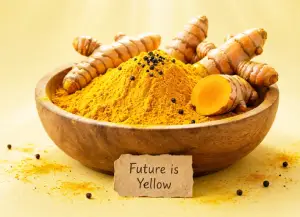
THE FUTURE IS YELLOW
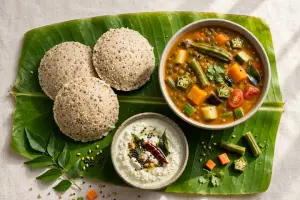
Millet Idli Sambar — Fermented Millet + Vegetables SOUTH
Two decades of research reviewed together shows clear benefits. A 2024 umbrella review in PLOS ONE analysing 49 previous papers found vegetarian and vegan diets are associated with better heart health, lower risk of cardiovascular disease, cancer and overall better medical factors. Another review of 21 studies found vegetarian diets reduced risk of colorectal cancer with relative risk 0.78 and type 2 diabetes with risk 0.73.
For diabetes, systematic reviews found vegetarian diets reduced HbA1c and helped weight control. NHS and Harvard now both advise: more plants, less meat = longer life.
Our daily sattvic thali is exactly what science recommends.
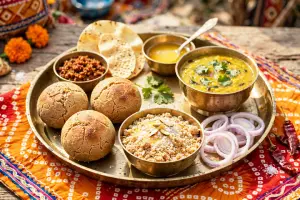
Makki di Roti, Sarson da Saag
PUNJAB — Makki di Roti, Sarson da Saag — with white makkhan, lassi in kullad and aam ka achar — served on phulkari thali
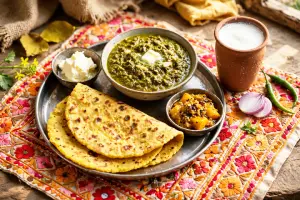
Dal Baati Churma
RAJASTHAN — Dal Baati Churma — brass thali with ghee, lehsun chutney, papad
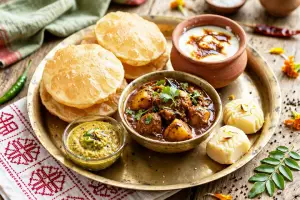
Alur Dom
BENGAL — Luchi Alur Dom with Mishti Doi & Sandesh — bell metal plate, kasundi on side
Turmeric is not just colour, it is medicine. The active part, curcumin, has been studied in hundreds of trials.
A 2024 review in Antioxidants confirms curcumin's anti-cancer, anti-obesity, anti-inflammatory, antioxidant and lipid-lowering effects. A 2024 meta-analysis in PLOS ONE of 14 randomized trials (349 people) found curcumin significantly lowered muscle damage and inflammation.
A 2024 systematic review in Nutrition & Diabetes (Nature) showed turmeric/curcumin supplementation significantly reduced body weight, waist circumference and body fat in patients with type 2 diabetes. High doses >1000mg were most effective. It also exhibits cardioprotective, antioxidant properties.
Ayurveda always said: haldi with a pinch of black pepper (kali mirch) increases absorption 20 times — now lab-proven
khichadi/mung
My Father's Choice
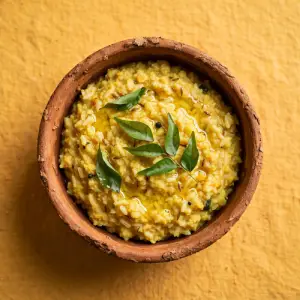
Khichadi
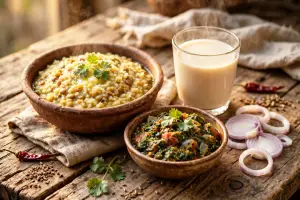
Khichadi Meal
Khichdi is not just food, it is comfort.
Just rice, dal, a little ghee and haldi - but together it gives you protein, fiber, easy digestion and peace of mind.
In every part of India we have our own khichdi. Pongal, Khichuri, Bisi Bele Bath, Dal Khichdi - same idea, different love.
It is the first food for a baby, and the food we eat when unwell. No heavy spices, no show-off, but full of strength.
UNESCO may not have given it an award, but in every Indian kitchen, khichdi is already the best meal in the world.
"Inspired by my father's favourite - moong dal, roti, chawal, and a simple green saag."
My Guruji's Choice
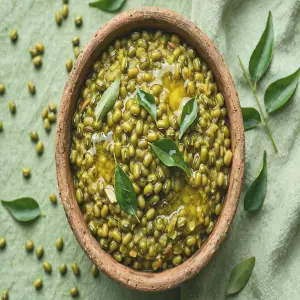
Mung
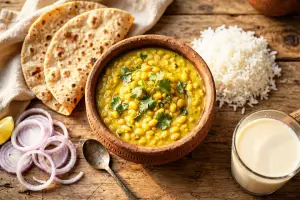
Mung Meal
Khichdi is not just food, it is comfort.
As my Guruji says, if one food had to be chosen for purity and goodness, it would be Moong Dal - light, nourishing and sattvic.
In temples, sadhus doing moong-only diet usually do it for 40 days or a few months for sadhana, and they add ghee, haldi, little rice, and fruits.
It is the first food for a baby, and the food we eat when unwell. No heavy spices, no show-off, but full of strength.
UNESCO may not have given it an award, but in every Indian kitchen, khichdi is already the best meal in the world.
जहाँ दाना, वहाँ जाना, वहाँ खाना
— My Guruji used to say
t means our food already knows where we belong. The grain calls you, you go, you eat, and that is your karma-bhoomi.
No need to chase.