




Founder's Roots
Pracharak Navtamgiri Gosai (Navtam)
Navtamgiri Gosai (Navtam) was born in the village of Mengni, near Rajkot, Gujarat, India. At the age of eight, he travelled to Uganda, Africa, to join his family. After completing his education in Uganda, he entered into business. In 1971, he settled in London, where he has lived and served the community for over five decades.
Navtam is a lifelong follower of Sanatan Dharm, an Ancestral Philosophical Art of Learning (APAL). Having experienced ways of living in India, Uganda, and the United Kingdom, he has gained a deep understanding of both modern and traditional values — and where they meet.
For Navtam, Sanatan Dharm is the thread that joins all living beings, especially humanity. In a world where more things unite us than divide us, he believes Sanatan Dharm is a proficiency that teaches the art of learning.
Having studied the Geeta at Oxford University and through parental teachings, this learning led to the creation of Shiv Parvati Nivas CIC — a community teaching centre in Westminster, London, to preserve Sanatan Dharm as a living education for us all, through the sacred stories of the 12 Jyotirlings and 51 Shaktipeeths.
Our Philosophy — Sanatan Dharm for All Humanity
At Shiv Parvati Nivas, we do not see Sanatan Dharm as a religion. Religion divides. Sanatan Dharm is eternal, universal guidance for all human beings on how to live a meaningful, balanced and purposeful life that leads to inner peace and ultimately Moksha — liberation and salvation.
Brahma, Vishnu and Mahesh, and their many Avatars, are the great advocates and teachers of this timeless guidance. Their teachings are not for one community or one country, but for all of humanity.
From this vast ocean of wisdom, Shiv Parvati Nivas is humbly focusing on two aspects most needed in today's world:
1. Family Values: Inspired by the divine family of Shiv, Parvati, Shri Ganesh and Kartikeya — the ideal of love, respect, duty, togetherness and sacrifice. We wish to promote strong, loving families as the foundation of a strong society.
2. Healthy Living through Healthy Eating: Inspired by the Satvik principles of our ancient teachings — pure, seasonal, balanced and compassionate food that keeps both body and mind healthy. For a healthy body is the first step towards a healthy spiritual journey.
Our aim is not to preach, but to share this goodness for the benefit of all human beings.
Sarve Bhavantu Sukhinah — May all beings be happy.
Parampara
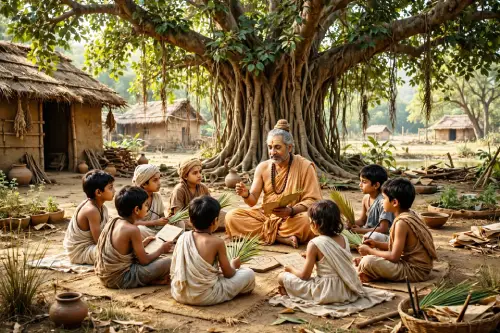
Parampara
(Father to Son, Mother to Daughter)
From time immemorial, the tradition of father-to-son and mother-to-daughter teaching has been established, so much so that in most cases the father or mother became a lifetime mentor to their children and kept the tradition alive.
Next, in the Gurukul / Vidyalaya (school) and later in the Vishwavidyalaya (university), students acquired proficiency in various subjects. In the Gurukul, no fee was asked in advance, and the student was free to pay what he could afford at the end of his studies, which became the budget for the following year. There was also a tradition of honouring the Guru (teacher) on Guru Purnima, when students offered what they could afford, which was regarded as the personal income of the Guru. The educational institutions simply enhanced the traditional values already taught at home by the students' parents.
The majority of these teachings are applicable to all children in any part of the world, such as respecting one's parents and elders, respecting the law of the land, and performing one's duties in a progressive way. Children were not discriminated against, and the atmosphere remained calm, pleasant and harmonious. Children were warned away from any harmful tatva (material or knowledge); for example, babies are warned about fire and children are warned about crossing a road, etc. Parents and teachers combined are known as society, which makes better citizens — as men make society, and society makes the man.
Society continues to remind everyone, from young to old, by referring to ancient gatha (stories) and kahavat (proverbs) of the great traditions. This would be the primary function of Shiv Parvati Nivas.

Shiv Parvati
(Sky and Nature)
Reflections on Climate Change
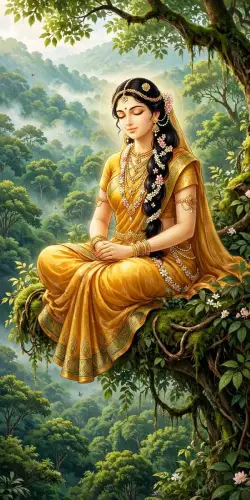
Every town and village has always ensured there is enough green space. We breathe out carbon dioxide and breathe in oxygen, which comes from the smallest plant to the largest tree. This is not a new phenomenon; it is perhaps as old as Mother Earth herself.
Even today, despite all our development, the developed land is still far less than the green cover that sustains us.Humans are the only species that continues to harm nature on an industrial scale, knowing well that the end — Pralaya — is near. Yet, even our smallest efforts can push that doomsday a little further away.
There is a beautiful story. Sitaji, Lord Ram's wife, went to the forest with her two sons to collect firewood. One son struck a young living tree. Sitaji immediately stopped him and made him apologise to the tree. She said, "We are here to collect only dead wood." Our history is full of such examples.
Through Shiva Parvati Nivas, we wish to bring this consciousness back to our community.
Respecting nature is respecting our own existence.